
Pre-Round Routine & Warmup
Level 2- Shooter McGavin

Welcome Avatar! Today we’ll cover how to properly get ready for a round of golf. A good warmup gives you the best odds of starting a round off well, lowering scores and making the game more enjoyable. Over time, it can also lead to game improvements, as it serves as a form of practice. Keep in mind, this is an ideal warmup. Feel free to leave some parts out if your home course doesn’t have everything available. Let’s dive in!
There are two ways you could structure a pre-round routine.
Dynamic Warmup, Putting Green, Short Game Area, Range
Putting Green, Short Game Area, Dynamic Warmup, Range
(Dynamic Warmup is preferable, but is optional)
This allows us to transition smoothly from the last full swing on the range to the first full swing on the course.
Dynamic Warmup
If you walk into the locker room of any college or pro event, you’ll find players doing a variety of stretches or mobility exercises before they step foot on the range. From experience, a dynamic warmup noticeably increases performance and consistency, as well as reduces the chances of getting hurt.
The main goal of a golf specific dynamic warmup is to prepare the hips, shoulders and upper back for explosive movement. We’re not fitness experts (we’ll leave that to BowTiedOx), but here’s what we do. Click the link on each for the proper form.
Anywhere from 5-10 reps each side works fine:
Leg Swings - Forwards-and-Backwards and Side-to-Side
PVC Pass Throughs - We just use a driver instead of a PVC pipe.
PVC Around the Worlds - Just use a driver
Optional: Walking Lunges, Side Lunges
If pressed for time, just do the World’s Greatest Stretch.
Should take 5-10 minutes. Others use different exercises; these are just some of the things we found useful from our training programs. Feel free to experiment.
Note: Light Cardio or a Weightlifting session can substitute for a pre-round dynamic warmup.
Putting Green (10-15 minutes)
There are a few goals: fine tune the putting stroke, get a feel for the speed of the greens, and get acclimated to the *appearance* of the greens.
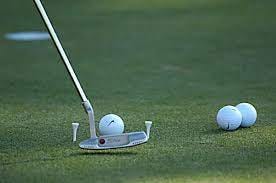
Stroke
Do some form of the gate drill. Made popular by the GOAT, find a dead straight putt between 4-6 feet. You can do this by backhanding putts, or using a digital scale. Once you find a straight putt, align your putter at the center of the cup, keep it there, and place two tees just outside of each end of the blade.
Hit putts focusing on making a stroke without contacting the tees. We typically do 5 putts right hand only, then 5 putts with both hands. Repeat until you’ve made 30 putts or so.
The gate drill forces you to prioritize center contact. Because of the gear effect, off center contact twists the the putter head, causing putts to start off-line. The drill also forces you to keep your head down. As outlined in a previous post, you’ll want to see a brief shadow/negative image on the ground after you strike the putt.
Variations: We use the Eyeline Putting Mirror as it saves time setting up the drill. It also lets you check the alignment of your eyes in relation to the target line. Another variation is to put a chalk line down on the line of the putt. This helps with alignment and priming your eyes to *see* the proper start line.
Speed
First of all, the rest of our activity on the putting green should involve 2-3 golf balls. Do not be the person who has 10 balls on the green and hits the same 20 footer over and over again.
Once you finish up with the gate drill, go immediately into hitting LONG lag putts (40+ feet). Focus on hitting putts within a roughly three foot circle. We think it’s important to take practice strokes when on the course. And. Don’t take practice strokes before the green. We want our *first instincts* to become familiar with the pace of the greens. Practice strokes get in the way of this.
Make sure you hit both uphill and downhill lag putts.
Mix it up by trying to leave one putt a foot short of the hole, another 2 feet long, etc.
Another way to focus on speed is hitting lag putts at the EDGE of the putting green, instead of a cup. Hit 25-50 foot putts to the edge of the putting green, attempting to leave the ball a few inches short of the fringe. We don’t do this very often, but definitely has utility.
Once you have a few sets of lag putts finish within 1-2 feet of the hole, move to 15-20 footers. Again, mix up the speed a bit. One ball 6 inches short, another ball 1 foot long, etc. This trains our pace control.
By now you may have noticed we’re not really concerned with making these putts. It’s by design. Making a good read is largely a guess (unless you use Aimpoint), and holing putts of this length is often a matter of luck. By developing great pace control, we give ourselves the best odds of matching speed to the break, as well as cutting down on three-putts.
Once you’ve made a few mid range putts, move to 5-8 foot putts.
Breaking Short Putts
If you can make tough short putts on the practice green, you can make the easy ones on the course. Pick a hole with significant slope (2.5-4% if you want to be precise). We do a few different mini-drills.
Throw 2-3 balls in random spots 5-8 feet from the hole. Spread them out enough so you’re not hitting two similar putts in a row. Give each of them a quick read from behind the ball, step up to them and make a good stroke, keeping your head down until well after the ball has left. Focus on holing these with the pace you VISUALIZE them going in at. Yes, speed is vital to holing short putts.
Hit 2-3 balls from the same spot, but try to make them with different speeds. One hitting the back of the cup, one going in at normal speed, and one barely rolling over the front edge. You’ll have to adjust the line to account for the different paces.
Focus on holing putts on one side of the hole, for varying breaks. Example: Hit a right-to-left and a left-to-right putt while trying to have them go in on the right side of the hole; then switch to the left side. You can also mix up pace as well.
All of these drills help in getting acclimated to the speed AND break of the greens. Once you’ve made a bunch of these in a row, move on to one last thing…….
Pick a straight 2-3 foot putt, and make roughly 10 in a row. Hearing the sound of the ball dropping in the cup primes you into thinking “I’m making everything”.
Short Game Area (<10 minutes)
There’s less of a method to warming up on the short game area. Essentially, you want to hit shots from a variety of conditions, in an attempt to get used to the firmness of the ground, how the club moves through the rough, how soft the sand is, and how much the ball bounces once it hits the green.
We recommend hitting no more than 5 shots in a row from a given spot. More than that accomplishes nothing.
Here’s a few ideas:
Short chips from the fairway. See how much the ball spins.
Short chips from the rough; ball sitting up, ball sitting down, into the grain, down-grain, etc. You can accomplish this by tossing balls in random spots.
Short sided bunker shots. Hit a few from uphill lies and downhill lies.
Medium range shots from the rough (10-20 yards). Short-sided pins, shots with tons of green to work with, downhill lies, sidehill lies, uphill lies, flop shots, etc.
Medium range shots from the fairway. High shots, low shots, bump and runs, spinners, etc.
You don’t need to cover all of these. Just make sure you’re hitting from *random* spots.
Range (15-25 minutes)
Do these few things on every shot:
Pick a specific target. It can be a flag, a tree in the distance, a fairway bunker, etc. Pick a specific target.
Pay attention to your alignment. Some tour guys like to aim an alignment rod or a club at the target, placing it on the *outside* of the golf ball. If you’re hitting a normal shot, make sure the grooves on the clubhead are parallel to the alignment rod. (below image)
Pay attention to your tempo. Hitting shots with the same tempo/rhythm on every shot will help you immensely when you get on the course.
Pay attention to where you are missing the target. Is it consistently 5 yards left? 3 yards right? If it is, you can adjust your aim on the course to account for your tendency.
Move through the session slowly. You SHOULD NOT be hitting golf balls constantly. If you watch the best in the world, they take their time in between shots. Take a few practice swings once in a while.
There’s a variety of ways to structure the range session, but here’s what we prefer to do. Each bullet point should account for 2-4 shots (with exceptions). The entire range session should come out to 45-65 golf balls.
Lower lofted wedge (56 or 54 degree)
Short wedge shots (30-50 yards)
Three-quarter wedge shots. Some low, some high.
Full wedge shots
Short Iron (8 or 9 iron)
Three quarter shots
Stock shots
A couple of fades and draws
A couple of high shots and knockdowns
Mid/Long Iron (4-6 iron) *Prioritize solid contact above all else*
Three quarter shots
Stock shots
A couple of fades and draws
A couple of high shots and knockdowns
Driving iron (if applicable) and Fairway Woods
Stock shots off the ground
Stock shots off of a tee
Throw in a couple fades and draws
Hit a few knockdowns/stingers if it’s windy
Driver
5-6 stock drivers
Throw in one or two fades or draws
If it’s windy, hit a couple of low ones
High lofted wedge
3-4 full shots
Mid-iron (7-5)
2-3 full shots
Whatever club you’re hitting on the first tee
3-5 of *insert whatever shot you’re going to hit on the first tee*
Feel free to put your own spin on it. We like to include a few swing specific drills, depending on how our game is progressing.
Final Note: Adjust the range session to the course and the conditions. If the course requires a lot of irons off the tee, hit some long irons off the tee. If it’s extremely windy, hit a bunch of knockdowns. If the course requires stopping the ball quickly on the greens, hit a lot of high shots. Etc.